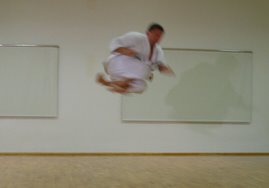
When i was 13 years old i was hugely impressed with our new VCR.... My mom let me rent a couple of videos pr week and i quickly got into the mysterious and captivating world of martial arts. Dubbed movies from Hong Kong, horribly ninja-sagas, vengeful samurais, Bruce Lee and similar characters all impressed me and i could not wait to start training. At the same time my mom was working far from home and my babysitter was a highly accomplished martial artist so i took her advice bout what to practice very seriously.... (she was a shotokan 6th kyu.... hihi)
However, as we were gonna move clear across southern norway i postponed starting until i was 14. At my new home there was a very solid Kyokushin dojo about 3 km away, but as i said; my expert friend had recommended shotokan so i had to ride my bicycle 17 km each way to train at closest the shotokan dojo.... (it was run by an awesome 3rd kyu, btw.... hihi)
This was a huge turning point in my life; i suddenly had passion and desire to accomplish something and even though i had failed at any other sport i tried, karate was patient with me. The fact that everyone just did their best and that no-one was ever ridiculed or looked down upon was enough to get me completely hooked.
The next part of my way is not a part i am proud of, nor do i recommend it; I did, however, drop out of school and devoted as much brainpower and physical effort into improving as i could muster. This singular focus made going through the beginning ranks of shotokan a rather swift affair. Speaking of ranks; the highest ranked karateka in norway at that time was an old gentleman called Egon Solem. He was a 5th dan and i was pretty sure he could fly.... Passing shodan just before my 18th birthday and getting my sandan only 5 years after that was two very proud moments in my life.
The 27th of june 2009 i passed my 5th dan test and it really makes my head spin.... 2 weeks after i turned 40, i had the extreme pleasure of fighting Tom Kompier sensei (among others), show my Gojushiho Sho, Heian Shodan and Meikyo. The fact that the audience included some of my peers from when i started training, some of my current committed students and friends from all over the world made it a very emotional moment for me.
I will strive even harder to improve my karate in the years to come.
To my main teachers, from the bottom of my heart, thanks for all your help and support:
(in alphabetical order)
Richard Amos
Enoeda Keinosuke
Kawasoe Masao
Geir Larsen
My biggest hope is that i can inspire someone in the way that you guys inspired me.
Monday, June 29, 2009


Wednesday, April 29, 2009
Kaizen-Kai
Kaizen is japanese and means continius improvement. Its my chosen name for my group of like-minded people. (Kai means group)
How do i think the concept of being a student of karate (or any skill for that matter) should change over time..... hmm.... I think most people *do not* study for their first time in our dojos, and the sooner they decide to immerse themselves, the better. Then; how long until i see my students as my "colleague"? For me the answer to that is whatever time it takes for the new student to develop a strong sense *ownership* of their karate. An solid opinion about how to execute our techniques and *why* it should be in the way they believe. Furthermore i think they should as soon as possible arrive at the level of understanding required for them to be their own most important instructor. A litmus-test would be something like: Can their karate improve without the input of anyone else? If the answer is yes; then i see the student as my peer.
And "how long time will that take" i hear someone think.... Depends; i would say that if you *study* a subject like shotokan karate-do; then 10 years or sandan should do the trick; whichever that comes first. However; even after 5 years and only the rank of shodan, i am ready to see people as my peers, if they really grow into having a strong belief in themselves and their skills.
Should they then stop studying? Ofc not, this is when it gets interesting.... You have taken the time and effort to get your body physically ready for martial art; you have developed a thorough understanding of the mechanics and mentality behind it all and therefore *now* is the time to develop this skill and also to give back to the karate-community in the way of helping others attain your level. This will get you better partners for your kumite and bunkai and we can then all pitch in to make sure our art does not degenerate into an olympic joke. (Harsh maybe, but its my firm belief that Nakayama sensei regretted some of the sports-efforts he helped to make popular)
In my opinion there is four levels of karate, and we can choose which group we will belong to.
1. Beginner
2. Student
3. Student / Teacher
4. Student / Master
Please note; i do not mean you have to run your own dojo or have a special rank to progress into level 3, nor do i think everyone with a very high rank fits into level four. Also note that i advocate the concept of continuing your study, no matter what your level. (Sometimes people have been "training" for 40 years, but in reality they have 1 year of experience 40 times. Its not the same as 40 years of experience, imnsho)
I hope you will think bout this and decide to upgrade to the next level shortly. You decide. Own it.
:-)
How do i think the concept of being a student of karate (or any skill for that matter) should change over time..... hmm.... I think most people *do not* study for their first time in our dojos, and the sooner they decide to immerse themselves, the better. Then; how long until i see my students as my "colleague"? For me the answer to that is whatever time it takes for the new student to develop a strong sense *ownership* of their karate. An solid opinion about how to execute our techniques and *why* it should be in the way they believe. Furthermore i think they should as soon as possible arrive at the level of understanding required for them to be their own most important instructor. A litmus-test would be something like: Can their karate improve without the input of anyone else? If the answer is yes; then i see the student as my peer.
And "how long time will that take" i hear someone think.... Depends; i would say that if you *study* a subject like shotokan karate-do; then 10 years or sandan should do the trick; whichever that comes first. However; even after 5 years and only the rank of shodan, i am ready to see people as my peers, if they really grow into having a strong belief in themselves and their skills.
Should they then stop studying? Ofc not, this is when it gets interesting.... You have taken the time and effort to get your body physically ready for martial art; you have developed a thorough understanding of the mechanics and mentality behind it all and therefore *now* is the time to develop this skill and also to give back to the karate-community in the way of helping others attain your level. This will get you better partners for your kumite and bunkai and we can then all pitch in to make sure our art does not degenerate into an olympic joke. (Harsh maybe, but its my firm belief that Nakayama sensei regretted some of the sports-efforts he helped to make popular)
In my opinion there is four levels of karate, and we can choose which group we will belong to.
1. Beginner
2. Student
3. Student / Teacher
4. Student / Master
Please note; i do not mean you have to run your own dojo or have a special rank to progress into level 3, nor do i think everyone with a very high rank fits into level four. Also note that i advocate the concept of continuing your study, no matter what your level. (Sometimes people have been "training" for 40 years, but in reality they have 1 year of experience 40 times. Its not the same as 40 years of experience, imnsho)
I hope you will think bout this and decide to upgrade to the next level shortly. You decide. Own it.
:-)
Sunday, April 12, 2009
Susan Boyle
What?? Have you not heard of her?? :o
Well, neither had I, until i saw this clip from Britains Got Talent 09
(I may have cried, but that is a secret....)
Enjoy
Well, neither had I, until i saw this clip from Britains Got Talent 09
(I may have cried, but that is a secret....)
Enjoy
Monday, March 16, 2009
Richard Amos sensei competing
All Japan kumite final in 94 against Yamaguchi sensei
Sorry bout the horrible video-quality but i am sure you will love the decisive finish to this match anyway.
Sorry bout the horrible video-quality but i am sure you will love the decisive finish to this match anyway.
Monday, March 09, 2009
Shotokan Kata performance
My opinion regarding the performance of kata is a subject i have blogged about before, so bear with me as i revisit this subject. I think real karate-do should be maintained as an art that has real potential to knock someone out (or worse) and i also think that kata is our "library" of technical ideas. Furthermore i think of them as a great way of drilling correct body mechanics, provided we do not change them to suit the whims of judges that sometimes are less than familiar with the subtleties of our style.
Does that mean i think we shall not change the katas, ever? Well, yes and no. I think its acceptable to change the kata if the new way will make for better mechanics and ease of understanding. If one needs to think bout whether this is wise, then i suggest comparing kata from 1955 and kata from 1985. One should be able to see that enhanced ways of training have produced a more polished look and smoother ways of moving throughout. Then for the changes i dont like; Theatrical entrance and exits, bowing that is too formal even if you meet the emperor, 5 seconds pauses in the middle of the kata, kiai-ing that sounds like people are being killed, excessive breathing and my biggest pet-peeve; changing the technique so that they *appear* faster and stronger yet in the process they lose any relevance to martial application.
Below here i have included some kata that represents the kind of karate-do that makes me wanna go and practice. In my opinion; None of these are "perfect" (nothing is) but to me this is art.
Mr Osaka; Bassai Dai
Mr Ohta; Nijushiho
Ms Mimura; WKF-Shitei kata Kanku Dai (Note the "illegal" dogi)
:-)
Does that mean i think we shall not change the katas, ever? Well, yes and no. I think its acceptable to change the kata if the new way will make for better mechanics and ease of understanding. If one needs to think bout whether this is wise, then i suggest comparing kata from 1955 and kata from 1985. One should be able to see that enhanced ways of training have produced a more polished look and smoother ways of moving throughout. Then for the changes i dont like; Theatrical entrance and exits, bowing that is too formal even if you meet the emperor, 5 seconds pauses in the middle of the kata, kiai-ing that sounds like people are being killed, excessive breathing and my biggest pet-peeve; changing the technique so that they *appear* faster and stronger yet in the process they lose any relevance to martial application.
Below here i have included some kata that represents the kind of karate-do that makes me wanna go and practice. In my opinion; None of these are "perfect" (nothing is) but to me this is art.
Mr Osaka; Bassai Dai
Mr Ohta; Nijushiho
Ms Mimura; WKF-Shitei kata Kanku Dai (Note the "illegal" dogi)
:-)
Friday, March 06, 2009
Wednesday, March 04, 2009
Which kata; what level....
In my opinion; Everyone should know all the kata below their level and at least one kata from the level above (preferably all on the next level, so that one can make an educated choice as to which kata to perform for the next test)
Then figure out which kata one like and which one does not like. The ones you like, you can probably do well (which usually is the reason we like stuff) and the ones you dont like are probably emphasizing a point that is weak in your karate. In my opinion, we should work on improving both of those. The ones like are the ones I recommend for tests and competing. When choosing kata for competition I suggest not going too low or too high in terms of difficulty-level. Most important is to gain a sense of happiness with what we do, so even though some parts of our kata is difficult, there is no reason to beat ourselves up and get frustrated with progress that may seem slow. Enjoy the process and make sure that you actively strive to get more confident and own your own karate. The sooner you can say; “It is what it is and i enjoy it” - the better.
Below is a list of the standard shotokan kata; Go through it and find both your favorite and the weak links. Try to figure out which you wanna do for your next test and lets have fun with it.
9-3 kyu
Kihon Kata
Heian Shodan
Heian Nidan
Heian Sandan
Heian Yondan
Heian Godan
Tekki Shodan
2kyu - Shodan
Bassai Dai
Kanku Dai
Jion
Empi
Hangetsu
Nidan
Bassai Sho
Kanku Sho
Nijushiho
Jitte
Tekki Nidan
Sandan
Gojushiho Sho
Gojushiho Dai
Sochin
Gankaku
Tekki Sandan
Yondan
Unsu
Chinte
Jiin
Wankan
Meikyo
The rank-levels I have set on these katas are meant as a rough guide and at danlevel you can often discuss this with the examiner and do your choice, even if I have listed it at a different grade.
Then figure out which kata one like and which one does not like. The ones you like, you can probably do well (which usually is the reason we like stuff) and the ones you dont like are probably emphasizing a point that is weak in your karate. In my opinion, we should work on improving both of those. The ones like are the ones I recommend for tests and competing. When choosing kata for competition I suggest not going too low or too high in terms of difficulty-level. Most important is to gain a sense of happiness with what we do, so even though some parts of our kata is difficult, there is no reason to beat ourselves up and get frustrated with progress that may seem slow. Enjoy the process and make sure that you actively strive to get more confident and own your own karate. The sooner you can say; “It is what it is and i enjoy it” - the better.
Below is a list of the standard shotokan kata; Go through it and find both your favorite and the weak links. Try to figure out which you wanna do for your next test and lets have fun with it.
9-3 kyu
Kihon Kata
Heian Shodan
Heian Nidan
Heian Sandan
Heian Yondan
Heian Godan
Tekki Shodan
2kyu - Shodan
Bassai Dai
Kanku Dai
Jion
Empi
Hangetsu
Nidan
Bassai Sho
Kanku Sho
Nijushiho
Jitte
Tekki Nidan
Sandan
Gojushiho Sho
Gojushiho Dai
Sochin
Gankaku
Tekki Sandan
Yondan
Unsu
Chinte
Jiin
Wankan
Meikyo
The rank-levels I have set on these katas are meant as a rough guide and at danlevel you can often discuss this with the examiner and do your choice, even if I have listed it at a different grade.
Subscribe to:
Posts (Atom)